Stake in Brunei: Domain, Licence and Risk Check

Evidence signal: amber. The name, the company that contracts with a customer, the domain used to access the service, and the recipient shown on a payment record are separate identifiers. For Stake, the exact domain considered here is stake.com. The accepted evidence confirms demand for that domain among Brunei-related gambling traffic, but it does not match the domain to a Brunei legal entity or local gambling licence.
That distinction controls the answer to “is Stake scam or legit in Brunei?” No supplied official record establishes fraud, so a red scam finding would be unsupported. Equally, no current primary record in the packet establishes local authorisation for the precise domain and entity, so a green finding would also be unsupported. The defensible result is an open-evidence assessment: proceed only after independently identifying the contracting entity, payment owner and complaint recipient.
Brand, domain and operator are not interchangeable
A recognisable name is only the first layer of an identity check. A domain identifies an internet address; an operator is the legal person offering the contract; a payment recipient may be another company; and a licence applies only within its stated scope. One identifier cannot safely substitute for another.
| Identity layer | What is established | What remains open |
|---|---|---|
| Brand | The reviewed name is Stake. | A brand name alone does not identify a Brunei contracting entity. |
| Domain | The exact domain assessed is stake.com. | No supplied record establishes local authorisation for that domain. |
| Operator | No Brunei entity has been matched in the accepted packet. | The legal contracting party and its jurisdiction require verification. |
| Licence | No matching Brunei licence was found in the supplied evidence. | Any foreign authorisation, its scope and present status are outside the accepted record. |
| Payment owner | No tested payment recipient is recorded. | The name appearing on a bank, card or wallet record is unknown. |
Before registration or payment, compare the exact spelling of the domain with the address bar and identify the legal name shown in the applicable terms. Then compare that name with the merchant descriptor or wallet destination presented at payment. If those names differ, the difference needs a documented explanation before funds are sent. A support agent’s assertion is not equivalent to a registry or regulator record.
What the Brunei demand record proves—and what it does not
The accepted traffic evidence is the July 2026 Brunei gambling-domain demand list, checked on 2 September 2026. It explicitly includes the exact domain. This supports a narrow claim: the domain appeared in that Brunei-focused demand dataset for the stated period.
Traffic or demand evidence does not prove that users completed deposits, received withdrawals or obtained effective support. It does not identify the operator, certify security, resolve legality or function as a licence register. Popularity can coexist with unresolved regulatory, contractual or payment questions. It should therefore be treated as discovery evidence rather than an endorsement.
| Question | Supported answer | Reason |
|---|---|---|
| Was the exact domain visible in Brunei-related gambling demand data? | Yes, for July 2026. | The supplied demand list explicitly includes it. |
| Does that establish a Brunei licence? | No. | A demand list is not a licensing register. |
| Does it prove withdrawals are paid? | No. | No withdrawal test or transaction record was supplied. |
| Does it prove the service is a scam? | No. | No official adverse finding or corroborated documented case was supplied. |
The correct reading is deliberately limited. The dataset answers a visibility question, while operator identity, local permission and transaction performance remain open.
Licence and legal position in Brunei
No matching Brunei gambling licence for stake.com or a corresponding Brunei entity appears in the accepted evidence. That absence should not be expanded into a claim that every possible foreign record was searched. It means only that local authorisation has not been established by the evidence available for this assessment.
The relevant primary legal text supplied is Brunei’s Common Gaming Houses Act, Chapter 28, checked on 2 September 2026. Readers considering gambling activity should consult the current official text and obtain qualified local advice where their circumstances require it. Access to a website, domain visibility or acceptance of a registration does not itself demonstrate that participation is lawful.
A claimed foreign licence would not automatically amount to Brunei permission. A useful licence check must connect four elements: the precise legal entity, the exact domain, the activity covered and the licence’s current status. The supplied packet does not complete that chain. For a broader explanation of this distinction, consult the Brunei licence and law guide.
| Verification step | Evidence needed | Current result |
|---|---|---|
| Identify contracting company | Current contractual terms naming a legal entity | Not established |
| Match company to domain | Competent register or regulator record covering stake.com | Not established |
| Confirm local authority | Current Brunei authorisation for the relevant activity | No match supplied |
| Check expiry and conditions | Dated official licence status and scope | Unknown |
Because these links are incomplete, “licensed somewhere” and “legal in Brunei” must not be treated as equivalent conclusions.
Payments, withdrawals and identity checks remain untested
No account was opened, no deposit was made, no withdrawal was requested and no identity-verification process was tested. Consequently, there is no evidence-led basis for listing available payment methods, processing times, fees, limits, supported currencies or document requirements. Those details may vary by account, location and payment channel, and they should not be inferred from general brand recognition.
Before paying, record the amount, currency, fee, recipient name, merchant descriptor and destination account or wallet. Confirm whether the payment recipient is the same entity named in the contract. Keep an unedited copy of the terms presented at the time, including any withdrawal, bonus, identity and account-restriction conditions. Do not rely solely on screenshots provided by an unknown intermediary.
| Transaction stage | Record to preserve | Warning sign |
|---|---|---|
| Before deposit | Terms, recipient name, amount, currency and fee | Recipient cannot be linked to the contracting entity |
| Identity check | Requested document type and secure submission route | Request arrives through an unrelated personal account |
| Withdrawal | Request time, status, reference number and response | Extra payment demanded solely to release funds |
| Dispute | Full chronology and transaction evidence | Pressure to delete messages or move to a new channel |
Identity checks can be legitimate compliance controls, but this packet does not establish how the service applies them. Sensitive documents should not be sent until the domain, recipient and stated purpose have been verified. Payment-risk principles are explained further in the payment guide.
Clone and impersonation checks for stake.com
Clone risk should be assessed separately from the underlying service. Fraudsters can copy names, colours, promotional language or support identities while directing users to a different domain or payment destination. The supplied logo helps identify the name visually, but it cannot authenticate a website or message.
Start with the address bar rather than a search advertisement or unsolicited link. Check every character in the hostname, including hyphens, substituted letters and additional words. A subdomain should be read from right to left to identify the controlling registered domain. A lock icon indicates an encrypted connection; it does not prove that the recipient is licensed, honest or associated with the expected company.
Do not install remote-access software, disclose one-time passwords or transfer funds to a personal account because someone claims an account must be “verified” or “unlocked.” If contact began through social media or messaging, return independently to the known domain and use a support route found there. Preserve headers, usernames, payment instructions and timestamps before blocking a suspicious contact.
Complaint recipient and escalation route
A complaint is more effective when it identifies the correct respondent. For an account decision, the first recipient is normally the contracting entity’s documented support or complaints channel. For an unauthorised payment, contact the bank, card issuer or wallet provider promptly. For impersonation, phishing or suspected fraud, preserve evidence and use the appropriate reporting channel. A regulator can only act within its remit.
The BDCB Alert List search, checked on 2 September 2026, is a resource concerning suspicious or unlicensed financial entities. It is not a casino-licence register and must not be used to infer casino authorisation. Its relevance depends on whether the issue concerns a financial entity or payment representation within BDCB’s remit.
| Problem | First practical recipient | Evidence to include |
|---|---|---|
| Account or withdrawal dispute | Documented operator complaints channel | Account reference, chronology, terms and transaction records |
| Unauthorised card or bank payment | Payment provider | Statement entry, date, amount and authorisation details |
| Clone or phishing contact | Relevant platform, provider or competent authority | Exact domain, message headers, usernames and screenshots |
| Financial-entity concern | Authority with the relevant financial remit | Recipient identity and payment instructions |
State only what can be proved. Distinguish a delayed request from a refusal, and a disputed term from an unauthorised transaction. The complaints and scam-warning guide provides a structured evidence checklist. Never pay an unknown recovery agent who guarantees a refund or asks for another transfer before acting.
Independent reviews are context, not a verdict
User reviews may reveal recurring themes worth investigating, but they do not independently establish the identity of a reviewer, the complete transaction history or the cause of a dispute. Positive reviews also cannot prove local licensing or predictable withdrawals. No user-review claim has been adopted as a fact in this assessment.
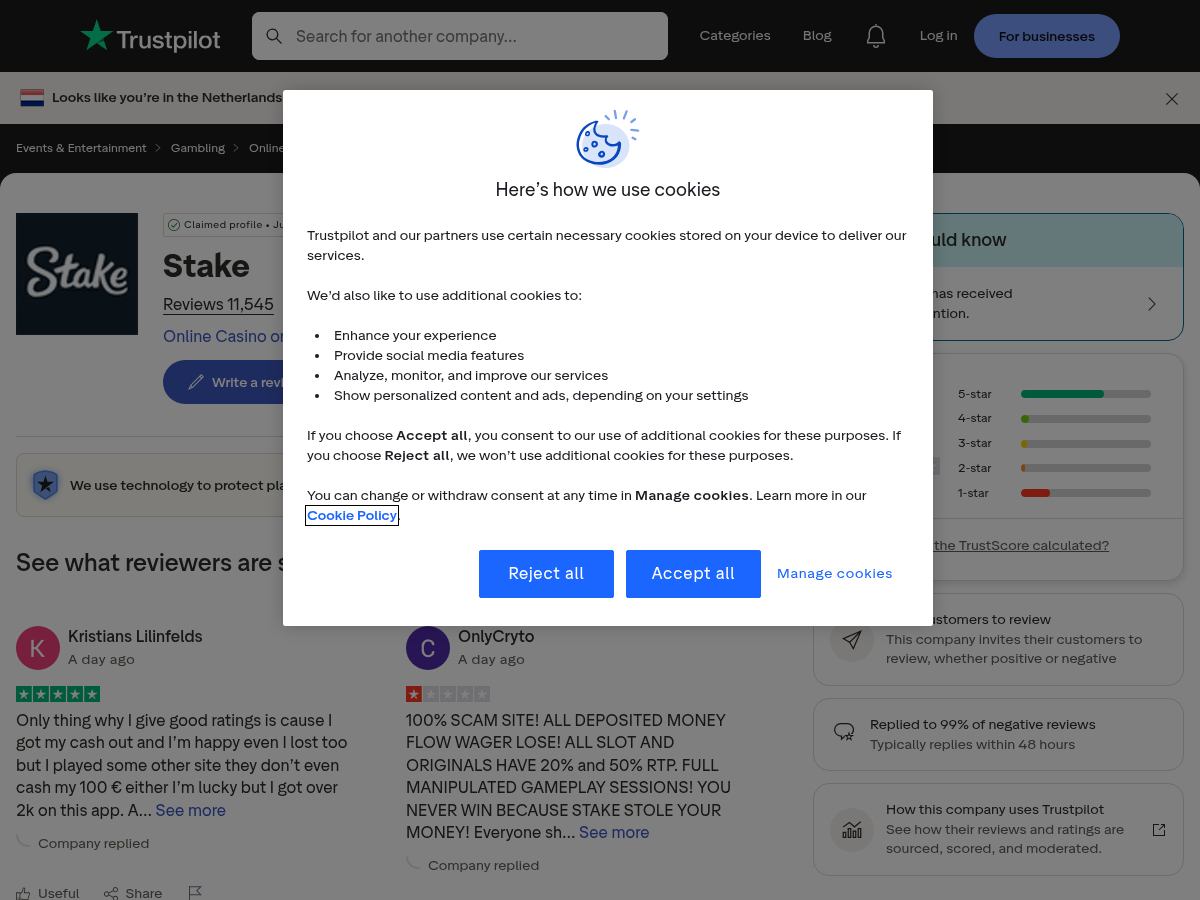
When reading review material, look for dated and specific accounts, then ask whether supporting records exist. Similar wording, referral-driven posts, missing transaction details or demands for off-platform contact reduce evidentiary value. Even a detailed allegation remains an allegation unless competent dated evidence establishes the underlying event.
Evidence chronology, method and unresolved questions
The demand record concerns July 2026. All three accepted primary sources were checked on 2 September 2026. The legal source provides statutory context, the demand source establishes domain visibility, and the BDCB source identifies a financial alert-list function. None supplies a complete operator-and-licence match for the exact domain.
| Date or period | Record | Permitted conclusion |
|---|---|---|
| July 2026 | Brunei gambling-domain demand dataset | stake.com appeared in the stated list |
| 2 September 2026 | Common Gaming Houses Act checked | Official statutory text was available for legal context |
| 2 September 2026 | BDCB Alert List checked | A searchable financial alert resource was available, not a casino register |
The method separates primary records from operator statements and user context. No account behaviour, customer service response, deposit, withdrawal or identity request was tested. No foreign licence claim has been accepted, because no verified record matching the entity and domain was supplied. The approach and evidence thresholds are described in the review methodology.
Material unknowns include the contracting legal entity, governing jurisdiction, payment recipient, withdrawal performance, complaint process and current identity requirements. New primary evidence could change the signal. A correction request should identify the disputed wording and provide a dated competent-source record through the contact route.
Conclusion: neither a green approval nor a red scam finding
The evidence supports one positive identification point: stake.com appeared in a July 2026 Brunei demand list. It does not establish a matching Brunei entity or local gambling licence. No official adverse record in the accepted packet establishes that the service is a scam, and no tested transaction supports a conclusion about payment reliability.
Amber therefore reflects unresolved identity, authorisation and transaction questions rather than a disguised approval. Anyone considering the service should first verify the exact domain, identify the contractual and payment entities, understand the legal position, and preserve records. Gambling can cause financial harm; limits and support options are available through the responsible gambling guide.
Frequently asked questions
Is Stake licensed in Brunei?
No matching Brunei licence for stake.com or a corresponding Brunei entity was established by the supplied primary records. A foreign licence, if claimed elsewhere, would not by itself prove permission in Brunei.
Does appearing in Brunei traffic data mean the service is legal?
No. The July 2026 demand list establishes visibility of the exact domain in that dataset, not legal permission, regulatory approval or successful customer transactions.
Is Stake proven to be a scam?
No official adverse record or corroborated documented evidence in the accepted packet proves a scam. However, unresolved operator, licence and payment questions prevent a green assessment.
Were deposits or withdrawals tested?
No. No account, deposit, payment method, withdrawal, fee, processing time or identity-verification procedure was tested, so transaction performance remains unknown.
How can I detect a cloned domain or fake support contact?
Check every character of the hostname, avoid unsolicited links, verify support through an independently reached domain, and never disclose one-time passwords or send funds to a personal account to unlock a withdrawal.
Where should a complaint be sent?
Send account disputes to the documented contracting entity, payment disputes to the relevant bank, card issuer or wallet provider, and suspected impersonation or fraud to the competent platform or authority. Preserve a dated chronology and original transaction records.